
 In what can only be described as a tool to incur repetative breaches of the Digital Millenium Copyright Act (DMCA), Yahoo (NASDAQ:YHOO) yesterday produced a tool that will purposefully strip out textual metadata, which includes copyright management information, ownership information, captions, and so forth, from images.
CNET reports (Yahoo web tool speeds up image shrinking, 10/6/08) on Smush It:
The operations Smush It can do include: convert GIF images to the PNG format; reduce the range of colours used in PNG files; strip out textual metadata from JPEG images.If you’re a lawyer representing photographers, you’ve got to be singing “Oh…happy day!”
(Continued after the Jump)
A read of the DMCA (THE DIGITAL MILLENNIUM COPYRIGHT ACT OF 1998, U.S. Copyright Office Summary, 12/98), page 6 lays out the problems this technology has:
Integrity of Copyright Management InformationNew section 1202 is the provision implementing this obligation to protect the integrity of copyright management information (CMI). The scope of the protection The Digital Millennium Copyright Act of 1998 is set out in two separate paragraphs, the first dealing with false CMI and the second with removal or alteration of CMI. Subsection (a) prohibits the knowing provision or distribution of false CMI, if done with the intent to induce, enable, facilitate or conceal infringement. Subsection (b) bars the intentional removal or alteration of CMI without authority, as well as the dissemination of CMI or copies of works, knowing that the CMI has been removed or altered without authority.
It goes on to define CMI:
There can be little doubt that this well intentioned product, designed to speed downloads, will in fact, speed you into multiple DMCA violations.Subsection (c) defines CMI as identifying information about the work, the author, the copyright owner, and in certain cases, the performer, writer or director of the work, as well as the terms and conditions for use of the work, and such other information as the Register of Copyrights may prescribe by regulation. Information concerning users of works is explicitly excluded.
In fact, checking Section 1201 of the DMCA:
Sec. 1201. Circumvention of copyright protection systems, subsection 3:Thus, you need not even have registered your work, under the Digital Millenium Copyright Act, 17 U.S.C. §§ 1201 or §§ 1202, in order to be eligible to bring a civil (or criminal) suit. A great resource and FAQ on this: Chilling Effects.) In fact, it didn’t take long for the US Department of Justice to indict a company for a “1201” violation (First Indictment Under Digital Millennium Copyright Act Returned Against Russian National, Company, in San Jose, California, 8/28/01):(b) ADDITIONAL VIOLATIONS- (1) No person shall manufacture, import, offer to the public, provide, or otherwise traffic in any technology, product, service, device, component, or part thereof, that—
`(A) is primarily designed or produced for the purpose of circumventing protection afforded by a technological measure that effectively protects a right of a copyright owner under this title in a work or a portion thereof;
`(B) has only limited commercially significant purpose or use other than to circumvent protection afforded by a technological measure that effectively protects a right of a copyright owner under this title in a work or a portion thereof; or
`(C) is marketed by that person or another acting in concert with that person with that person’s knowledge for use in circumventing protection afforded by a technological measure that effectively protects a right of a copyright owner under this title in a work or a portion thereof.
`(2) As used in this subsection—
`(A) to `circumvent protection afforded by a technological measure’ means avoiding, bypassing, removing, deactivating, or otherwise impairing a technological measure; and
`(B) a technological measure `effectively protects a right of a copyright owner under this title’ if the measure, in the ordinary course of its operation, prevents, restricts, or otherwise limits the exercise of a right of a copyright owner under this title.
The United States Attorney’s Office for the Northern District of California announced that Elcom Ltd [was] indicted today by a federal grand jury in San Jose, California on five counts of copyright violations… The DMCA requires that the government prove a defendant offered to the public, provided, or trafficked in technology that was primarily designed to circumvent copyright protections, or was marketed for use in circumventing copyright protections…According to the indictment, Elcom and Mr. Sklyarov are alleged to have conspired, for commercial advantage and private financial gain, to traffic in a technology that was primarily designed and produced for the purpose of circumventing, and was marketed by the defendants for use in circumventing, the Adobe Acrobat eBook Reader.I surely expect that Yahoo’s promotion of this tool, with the expressed purpose of removing textual metadata, will get their Exceptional Performance Team in a bit of hot water. Check this Yahoo Developer blog video, about 34 seconds in, to see item #3 – “strip JPEG meta” (note – the audio is useless, but the screen visual makes the point) is where the problem lies. They could easily make it strip all the metadata BUT the copyright and ownership information.
Here’s my image from yesterday’s blog entry showing the before and after of both the visual effects, as well as the textual metadata wiping. (click the image below to open in a new window full size)
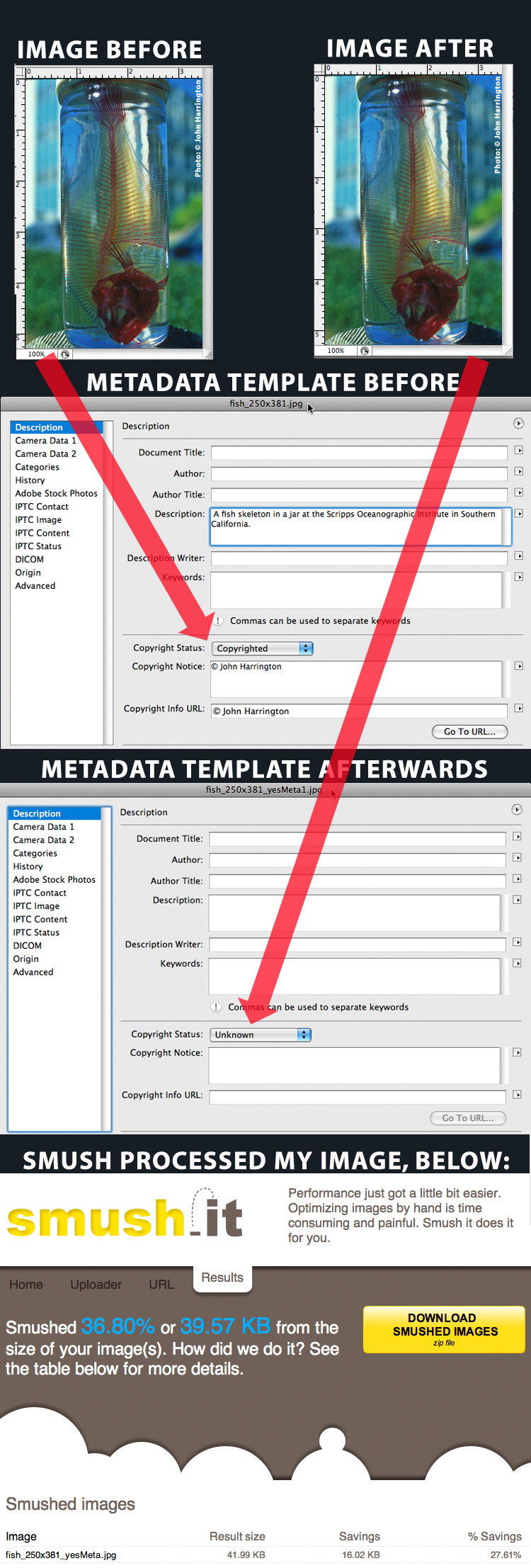
We need not look for “bad actors” looking to strip ownership information from our images under the soon to die and yet will reappear next year Orphan Works Act – well meaning people are producing products that will orphan every image it processes – intentionally.
Yet one more reason why Orphan Works, as written, is horrible for everyone.
———
Update: Check the comments below. It seems that the developers have been responsive to the issues raised, and have ensured the preservation of the metadata. Thank you, Yahoo!
Please post your comments by clicking the link below. If you’ve got questions, please pose them in our Photo Business Forum Flickr Group Discussion Threads.
Originally published on Photo Business News & Forum on October 7, 2008. Comments are closed; this post is part of the archive.
I guess this bit of information struck a nerve when I passed it on to you yesterday?
I was unable to find an email address, but did find that Yahoo has a forum where you can leave “suggestions” which might prove to be even better since other developers may see them.
http://developer.yahoo.net/forum/index.php?showforum=22
I hope everyone can take a few minutes to let them know how you feel.
I’ve posted my thoughts on this at:
http://developer.yahoo.net/forum/index.php?showtopic=186
or
http://tinyurl.com/3gll62
In summary for the readers of this blog, I noted that this was one of the points which we were trying to make with the publication of the Metadata Manifesto (http://www.stockartistsalliance.org/metadata-manifesto-4) and accompanying Metadata Manifesto Blog (http://metadatamanifesto.blogspot.com/) starting back in 2006.
Specifically:
As a Technology Provider
* Insure that your products are compliant with current metadata standards, and backwards compatible with legacy systems and standards.
* Make preserving metadata the default option when copying, saving or exporting any image.
* Insure that user interfaces-for operations that remove metadata-are designed to allow users to clearly understand what they are about to do.
For a team that supposedly “evangelizes best practices for improving web performance” I find the lack of concern for anything other than speed (“Best = Fast”) to be short-sighted in the face of all of those that are creating images in order to make a living.
David Riecks
—
Stock Artists Alliance Photo Metadata Project leader
http://www.stockartistsalliance.org/photometadata-project
Chairman, SAA Imaging Technology Standards Committee
Thanks for the great feedback on smush it. It is feedback from the community that makes an open source tool go from good to great.
We are actively working on preserving copyright information in JPG, while removing other, less important metadata. We have a request in to our provider to upgrade Image Magick. When that is complete, this will be a simple change to make.
If you have any feedback about specific chunks of data that are important to keep, please do forward that along to Stoyan and I via our feedback form on the tool itself.
Cheers,
Nicole
On our end we’re using a free open source tool called jpegtran, created by the creators of the JPEG itself, if you happen to know, or know anyone that knows, what are the options of jpegtran that will allow us to reduce file size while retaining copyright, please let us know.
But rest assured that we’re on it. I consider myself a creative person too and cannot live with the thought a tool I created might be causing, even involuntarily, artists to suffer.
Best regards and I’ll keep you posted on the progress.
Best,
Stoyan
p.s. smush.it is a tool me and Nicole created in our own time and with best intentions. It’s not a Yahoo tool so we’re solely responsible for it.
since the proper solution – stripping needless meta while keeping copyright info will be a little involved, as a temporary solution we’re keeping all the meta. The saving are no longer that impressive, but we’re be working on the right solution that helps performance and doesn’t harm artists.
Once again, thanks to everyone who brought the issue to our attention.
Using Tineye is an amazing experience, but even when they reach a few billion images indexed(which should be any time now, if not already), and beyond (wheen I expect that the search responses will not be so incredibly fast as they are today), Tineye will not provide anything more than a looking glass view into the world of infringements of a particular works.
So where is TinEye headed? Think mobile advertising. using your TinEye enabled cellphone to capture images of billboard ads, bus stop ads, subway ads, magazine ads, etc. and receive a text message with a special offer from the advertiser. Forget the photo business. Cha Ching! TinEye>>>GoogleEye
I like the neat, cutesy name for this software snake. With a name like that how could it be so evil. But yet when you’re not looking this thing bites you on the ass.
I say I don’t believe them.
Thanks a lot for the post, really interesting.
—————–
Jessi
Guaranteed ROI
Questioning it last week, I received the following reply from Daniel Cooper Fox’s VP of business & legal Affairs:
““By displaying or publishing (“posting”) any Content on or through the MySpace Services, you hereby grant to MySpace a limited license to use, modify, delete from, add to, publicly perform, publicly display, reproduce, and distribute such Content solely on or through the MySpace Services, including without limitation distributing part or all of the MySpace Website in any media formats and through any media channels, except Content marked “private” will not be distributed outside the MySpace Website. “ (emphasis added).
Accordingly, our Terms of Use, which all members of MySpace must agree to, permit us to strip away certain information from uploaded files, which is required because of the size of the data at issue.
“
Any Thoughts?